Just as it will only take 1% of people, nonprofits, businesses and governments to participate, it will only take 1% of philanthropy for Unite for Rights to succeed. Philanthropy can unite to unite humanity. Philanthropy can collaborate to support and create an International Bill of Rights. By doing so, many of the problems philanthropy addresses can be eliminated, or reduced, so they are not as prevalent.

Julia Stasch, a past President of the MacArthur Foundation, has said that the responsibility to serve the public good “challenges us to periodically revisit our mission, to consider whether our areas of focus, our objectives, and our approaches are sufficiently bold, flexible, inventive, and effective, and to ensure that we are tackling some of the world’s most profound issues as they rapidly evolve.”
In other words, it’s time for rethinking. As President Stasch explains “the times demand that we question long-standing orthodoxies, established assumptions, comfortable practices, and even goals.”
This insight and advice is true: the question is whether it will be applied. Are other philanthropic leaders, foundations and individuals willing to lead to “bring in the new.” Precisely, are philanthropic foundations willing to join on the globe as green lights to show their support for an International Bill of Rights?
Will philanthrpists allocate 1% of their funding towards a “systems-based” approach, along with thousands of other foundations, to address the problems of the world in a systemic way? Will 1% of philanthropy go upstream? (See Blog #8).
The tension between addressing immediate problems and acting to prevent them from occurring, reminds me of a poem: “An Ambulance or a Fence” written by Joseph Malins in 1895.
‘Twas a dangerous cliff, as they freely confessed,
Though to walk near its crest was so pleasant;
But over its terrible edge there had slipped
A duke and full many a peasant.
So the people said something would have to be done,
But their projects did not at all tally;
Some said, “Put a fence ’round the edge of the cliff,”
Some, “An ambulance down in the valley.”
But the cry for the ambulance carried the day,
For it spread through the neighboring city;
A fence may be useful or not, it is true,
But each heart became full of pity
For those who slipped over the dangerous cliff;
And the dwellers in highway and alley
Gave pounds and gave pence, not to put up a fence,
But an ambulance down in the valley.
“For the cliff is all right, if you’re careful,” they said,
“And, if folks even slip and are dropping,
It isn’t the slipping that hurts them so much
As the shock down below when they’re stopping.”
So day after day, as these mishaps occurred,
Quick forth would those rescuers sally
To pick up the victims who fell off the cliff,
With their ambulance down in the valley.
Then an old sage remarked: “It’s a marvel to me
That people give far more attention
To repairing results than to stopping the cause,
When they’d much better aim at prevention.
Let us stop at its source all this mischief,” cried he,
“Come, neighbors and friends, let us rally;
If the cliff we will fence, we might almost dispense
With the ambulance down in the valley.”
“Oh he’s a fanatic,” the others rejoined,
“Dispense with the ambulance? Never!
He’d dispense with all charities, too, if he could;
No! No! We’ll support them forever.
Aren’t we picking up folks just as fast as they fall?
And shall this man dictate to us? Shall he?
Why should people of sense stop to put up a fence,
While the ambulance works in the valley?”
But the sensible few, who are practical too,
Will not bear with such nonsense much longer;
They believe that prevention is better than cure,
And their party will soon be the stronger.
Encourage them then, with your purse, voice, and pen,
And while other philanthropists dally,
They will scorn all pretense, and put up a stout fence
On the cliff that hangs over the valley.
Better guide well the young than reclaim them when old,
For the voice of true wisdom is calling.
“To rescue the fallen is good, but ’tis best
To prevent other people from falling.”
Better close up the source of temptation and crime
Than deliver from dungeon or galley;
Better put a strong fence ’round the top of the cliff
Than an ambulance down in the valley.
This poem, “An Ambulance or a Fence”, captures the state of philanthropy today. A bias towards ambulances prevails, and few philanthropies will fund the building of a fence – a “systems-based” approach. Even fewer will band together to build a fence.
But this may change; Unite offers a path to this change.
Given present momentum, it is not easy to convince people, nonprofits, businesses and governments to construct a fence. It takes courage “to challenge established assumptions, comfortable practices, and even goals”, but it needs to be done. Not to replace the ambulance, but to complement it. Considering the cataclysmic problems we face: the prospect of nuclear war; the despoiling of our biosphere for Earth, the ever increasing disparity of wealth, and the rampant rise of athoritarian leaders, we must act at the level where these problems originate.

99% of all philanthopy can, and should, go to building ambulances, but it is also time for 1% of all philanthropic funding to go toward a systems- based approach like an International Bill of Rights and building a fence.
Unite constructs the fence in two ways: 1) Unite brings people, nonprofits, businesses and governments together on a globe to support an International Bill of Rights; 2) By “drafting through dialogue,” Unite facilitates the writing of an International Bill of Rights that can be put into a treaty, approved, and implemented through the United Nations General Assembly.
Each country can then decide if it wants to be part of the treaty, just as was done for the Universal Declaration of Human Rights. When 50 countries have ratified the International Bill of Rights document, then the International Court of Human Rights will begin hearing cases.
This is not an epiphany. It is the fulfillment of Article 28 of the UDHR which recognized that the UDHR was unenforceable, and that the time would come (which is here now), when the rights in the UDHR would need to become enforceable in courts of law, not just the court of public opinion.
The International Bill of Rights which Unite for Rights has helped to facilitate drafting for 15 years (you can see the latest draft on the Unite website) is the fence.
The logo of Unite for Rights includes four intertwined figures: purple for people, green for nonprofit organizations, blue for businesses, and orange for governments
 All are Uniters; no Uniter has any more power than any other as to what rights should be included in an International Bill of Rights.
Every human brings the same power to the table to draft an International Bill of Rights. True, it is unorthodox to think that all foundations and philanthropic individuals will direct 1% of their giving to unite for the common good, but as Rene Cassin said when he was awarded the Nobel Peace Prize for his work on the UDHR and the European Court of Human Rights: “It works.” It does work.
The realization of the UDHR through the European Convention of Human Rights and the European Court of Human Rights is the best protection and enforcement of human rights in the world today.
Now, it is time to fund the remodeling and improvement of the African Court for Human and People’s Rights and the Inter-American Court of Human Rights with 50 million Euros each, to bring these two Courts up to the level of the European Court of Human Rights.
While this is being done, the stregthening and expansion of other Regional Courts, as can be seen on this map, should be undertaken.
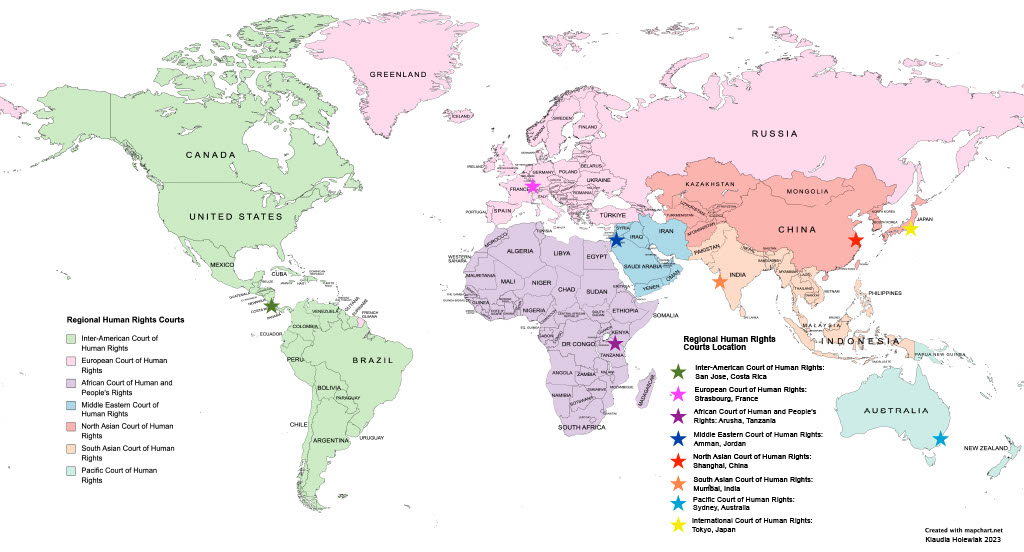
CLICK HERE TO SEE AN ENLARGEMENT OF THIS MAP! 2023 Jan 4 Map of Regional Courts
People internationally are ready to build a fence of enforceable fundamental rights for all; philanthropic funding provides the means to do so. Translation, for example, is necessary.
The situation today is that the people are more willing to live together in peace and prosperity within an international community than their governments. Just 1% of philanthropy can provide the leadership to revive the most comprehensive international social movement of all time, the Universal Declaration of Human Rights.
When People, Nonprofits and Businesses unite to strengthen and expand the existing regional court system, Governments will follow. Philanthropy can lead by enabling those willing to unite to have a platform to do so: We can build this fence together.

The construction of this fence has been underway for centuries!

Let’s celebrate, and continue to build it with the support of 1% of philanthropic funding internationally. Cheers to those who began in 1948, including philanthropies who supported the Universal Declaration of Human Rights then, and who later proceeded through the interim years, and continue now, to strive to make the UDHR “fully realized”.
Thanks to you, the future does belong to those who believe in the beauty of their dreams.


Leave a Reply