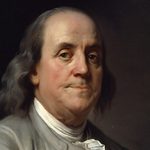
Benjamin Franklin, American founder and inventor, said “Failing to plan is a plan to fail.”
An International Bill of Rights (IBOR) is the foundation of Unite for Rights. The IBOR is a “plan for humanity”.
Unite’s plan is an international social movement, a renewed “overstory” as Malcolm Gladwell calls it, embodied in the four figures of the Unite for Rights brand: the moment when people, nonprofits, businesses and governments unite to tell the story of rights for all, enforceable by all, in the courts of all countries.
 We have advances in Medicine, Physics, Psychology, Computer Science, Food, Music, Biology, Environmental Science…this list is long, and growing. Law and Democracy should be on this list.
Law is an agreement to live together. It can be a local town ordinance, a state or national statute, or an international treaty. All are agreements on how we will live together. The problem humans face is that the stories we are telling are much smaller than our existence together. It’s time for a plan that matches the breadth of our existence.
Human rights organizations, religious institutions, businesses and governments are dancing on the periphery of humanity’s major problems. And I’ve been dancing with them: but the problems we face, nuclear war, the destruction of our biosphere, emergence of AI beyond our control, and the breakdown of family as a core human institution, all require broader thinking and a better, bigger, plan for us to tell each other and carry out.
The remarkable gift that humans have, unique to them, no other species, is that humans can read and write. We can put our agreement to live together, a new plan, into writing, as is evident from the Universal Declaration of Human Rights.

Part of the plan of Unite, in accordance with Article 28 of the UDHR, is to carry out the plan of the UDHR. Unite is not a new plan – it is the further implementation of an ongoing one.
A wise plan looks back and plans forward. An International Bill of Rights is prescient. It looks back to the way humanity has acted in the past and prepares for these acts in the future.
In his book, Nexus, Yuval Noah Harari calls this ability to create a document in anticipation for future events “a self correcting mechanism.” It is forseeable that there will always be those who will seize power for themselves, violating the rights of others. An International Bill of Rights is a powerful “self correcting mechanism” capable of securing humanity’s social contract, our fundamental rights, when our leaders falter, as all humans do at times.
That document, an International Bill of Rights, is on the table before you – have the imagination and courage to be a part of the plan! Each of us is needed to make this happen.
Democracy is self governance. No one gets to govern because they were luckily born into a particular family or through some religious lineage. People are only allowed to govern when they are freely chosen by other people, and then they are required to follow the rules provided by those who are governed. As Rousseau said, “the people build the machine, the Prince merely operates it.“
Given the global challenges we face, climate change, rising authoritarianism, increasing wealth disparity, pandemics, and now wars breaking out in various locations, it is time for people in all countries to plan together for enforceable law in all countries — to save ourselves, and the planet on which we live, Earth.
Narrow minds default to the impossible. Open minds realize there is a fine line between the impossible and the inevitable and try to cross it. As Eleanor Roosevelt, the “First Lady for the World” said: “We must do the thing we think we cannot do.“
Many may say that we cannot reach an international agreement to live together based on fundamental rights for all. They say “We will never agree.” At Unite for Rights, we live by the response Eleanor would give when she was working on the Universal Declaration of Human Rights and was dismissed by naysayers: “Let’s see”; “Let’s ask”; “Let’s Do!”
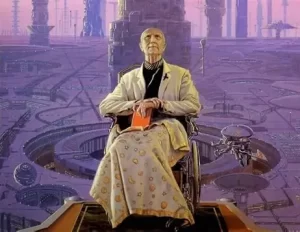
Planning ahead is a good way to help determine where you will end up. There is a character named Hari Seldon in the Foundation series, written by Issac Asimov.
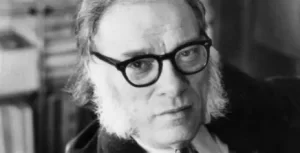
In Foundation, psychohistory is a fictional branch of mathematics developed by Seldon. It combines history, sociology, and statistical analysis to predict the behavior of large populations over time. Psychohistory does not focus on individual actions. Instead, it identifies the collective trends of massive groups, such as civilizations, empires, or societies.
The intriguing idea of Hari Seldoon is that it’s possible to shape humanity’s future through planning. This is true, it’s possible. The 34 Articles in the International Bill of Rights are a plan for the future of humanity – they create a trajectory away from war, ruin of our biosphere, and assure that even with massive disparities of wealth (we just crossed the threashhold where 1% of humanity now has more wealth than the bottom 80%) there is a minimum standard of well being for all.
In the television version of Foundation, Hari Seldon uses a large spinning globe-like depiction of the potential paths for humanity. Threads of light depict the current trajectory of humanity and possible alternatives. The premise is that by planning the reorganization of humanity as a whole, it’s possible to shift to a more favorable trajectory.
Unite, and the International Bill of Rights, do this – they shift humanity’s trajectory. This is why it is worthy of your time and funding. Rather than spending time and money cleaning up after the mess caused by a flawed trajectory, it possible to redirect the trajectory. In philanthropy today, this is called “systems-based” giving and it’s a wise investment.
We can no longer leave our individual well-being to random chance, or the market, they alone are not enough. We must plan; We must act.
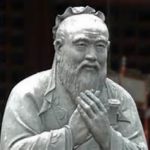
For, as Confucius said “He who doesn’t look at what is distant will find sorrow near at hand.” Here we are, faced with potential World War and the devastation of our planet’s biosphere.
Sorrow is near at hand because of our lack of planning at the level of the problems we face: they are global. Our myopic nation-state focus is leading us to disaster. We need to plan at multiple levels: city, state, nation, regionally, and internationally. An International Bill of Rights does this.
Planning ahead is the means by which we avert calamity, whether it is the climate crisis, or another World War. Don’t be dismayed by the enormity of the task. The success of the plan only requires 1% of all people, nonprofits and businesses. Please be one of the 1%! When the path to a plan is worn, others will follow.


Leave a Reply